
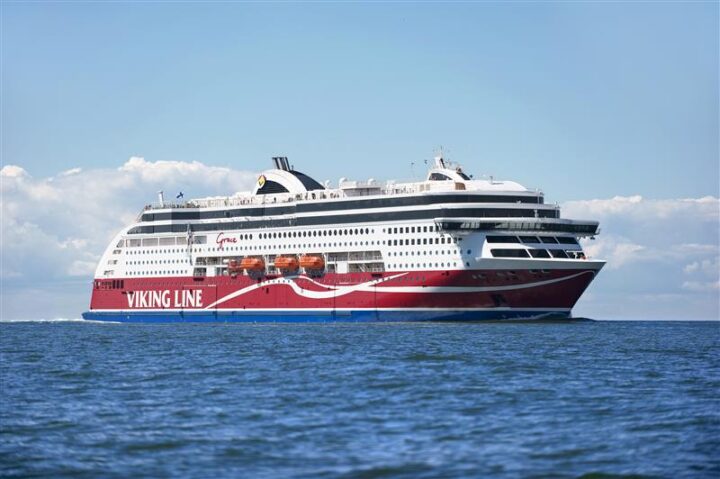
"Viking Grace is the world’s first passenger vessel to use liquefied natural gas (LNG) as fuel. Ensuring safety requires top-level gas detection – a standard delivered by Detector."
Viking Line is one of the most well-known ferry operators in the Baltic Sea and a pioneer in environmentally friendly passenger transport. Viking Grace is the world’s first passenger ship to use liquefied natural gas (LNG) as fuel. In addition to environmental responsibility, Viking Line is deeply committed to uncompromising safety for both passengers and crew.
The challenge
LNG is a clean and efficient fuel, but its handling and storage require precise safety management. In a ship environment, quickly detecting gas leaks is critical, as any deviation can pose a threat to both passengers and the operation of the vessel. In the case of Viking Grace, the challenge was not limited to LNG alone: multiple safety-critical areas had to be monitored simultaneously.
On the car deck, the system must detect fuel leaks and hydrocarbons from vehicles. In the wastewater treatment area, hydrogen sulfide must be controlled. Potential refrigerant leaks require close monitoring, and oxygen levels must be tracked, particularly in areas where nitrogen is used. Alongside all of this, the continuous monitoring of LNG and methane is an essential part of the vessel’s overall safety.
The solution
Viking Grace was equipped with gas detection systems from Detector Oy, specifically designed to meet these complex challenges. Our devices monitor LNG systems, hydrocarbon and fuel emissions on the car deck, hydrogen sulfide in the wastewater system, refrigerant leaks, and oxygen levels in various areas — all in real time. The data integrates directly into the ship’s overall safety system, so alarms appear immediately and allow the crew to respond without delay.
The benefits
Detector’s solutions ensure that any gas leaks or anomalies are detected instantly and dealt with effectively. This improves passenger safety, protects the crew, and supports Viking Line’s high safety and environmental standards. The reliable and serviceable system reduces the risk of downtime and ensures uninterrupted operation of the vessel.